|
Frequently
Asked Questions
0.
Why haven't
we
build SSP already??
Answer 0. Space
transportation costs using
old rockets have been too high, since we throw
the
rocket away
after each flight! That’s no way to run an airline!
Reusable
rockets are the key. Most importantly, costs
go down when volume goes
up. That is why your TV doesn’t cost a
million bucks. We need a much higher volume to orbit
to make the
lower cost reusable
space vehicles pay for themselves. Only SSP, however,
provides the huge
market
volume needed to finance the low-cost space
transportation vehicles
necessary. This
chicken and egg situation is characteristic of several
other SSP
materiale requirements. See next question, for further
details, but
that is why a strongly financed
company is
necessary to
successfuly
build
SSP.
1. How much
would
SSP cost?
Answer 1. The
key to
understanding SSP construction costs, is to know
today’s launch to
orbit cost is
too
high. These costs must be brought down. A serious
decision to move
forward with SSP means that company must have major
financial resources
to weather the five to ten years of design and
development and
contracting for the massive quantities of space
transportation,
photovoltaics, transmitter and structural elements,
etc that are a
hundred times greater than existing demand for these
specialized
products. Higher volume is
the way to lower cost, as the graph for space
transportation costs (Fig. 1)
below shows:

Only
a much larger launch market can lower these
costs. SSP is the only such huge market we know of
with the volume
required to
enable the low-cost space transportation system
necessary for a
successful SSP
business case. Sort of a chicken and egg situation,
got to have one to
get the
other. Low cost transportation to orbit to GSO is
critical; launch
costs to GSO
must be reduced from thousands of dollars per pound to
about
$150/lb. The current leader in low cost to orbit
is SpaceX. They
currently quote about $50 million to put 3000 kg into
Geo Transfer
Orbit or
about $10,000 per pound to GSO.[1]
SpaceX
plans to add the necessary thermal protection
to allow for first stage recovery on Falcon 9's fifth
flight, probably
in 2012.
At $35 million to manufacture, Elon Musk, SpaceX CEO,
says that an
efficient
refurbishment
and launch operation could bring Falcon 9's per-launch
price down to
about $1
million. To get the launch price to $1M, the amortized
manufacturing
cost would
need to equal refueling costs, or about $200,000. That
goal implies
reusability
for 175 times - within a short enough time frame that
the cost of
capital
doesn't increase the amortized manufacturing cost.
That
usage rate far exceeds current or projected
launch demand.[2]
But if
the market demand were there, the price would
then be about
$50/lb to
LEO or
about $100/lb to GSO! And that is with near term
technology. This
theme
repeats through other costs. We need a STRONG
financial entity to
shoulder
these linked financial and technical challenges. This
why the Space
Solar Power
Workshop recommends that Congress charter a Sunsat
Corp to build a power satellite
industry, just as they
chartered Comsat Corp, which built our very successful
communications
satellite
industry. Japan’s USEF consortium has budgeted $2
Trillion yen (~US $25
Billion) to kick-start SSP by 2025.
They
expect to be able to provide SSP
electricity to customers at eight yen (nine cents) per
kilowatt-hour, six times cheaper than its current cost
in Japan. A
sample projected budget for a Sunsat Corp
is
available at the Space Solar Power Institute website.
2. Would the
cost be more or less
than that
of other sources of energy being used currently?
Answer 2. The
cost without the
strength of
a Sunsat Corp would be too high. The Japanese USEF
consortium, the only
well
funded SSP effort now in existence has a project
funding of $2 Trillion
yen
(~US $24 Billion)[3]
3. Why
is SSP being
considered to
replace other sources of energy?
Answer 3. Here is a short list of what
makes SSP so
attractive compared to
existing competing energy alternatives.
I. SSP
could
provide
virtually
unlimited
quantities
of
clean,
baseload
energy,
without
many of the negative aspects of the
fossil
fuels, (coal, oil and natural gas) currently in use.
The rising price
of oil is
tightly linked to the rising
price
of
food and other commodities that are processed,
packaged
and
transported as
global
demand is increasing for oil, coal, gas and biofuels.
Weather, or
climate change,
is also an inextricable part of this equation. This shift
pushes land use
from agricultural or wilderness
into producing biofuels such as corn to ethanol or
fuel oils, such as
palm oil.
Our “footprint” on our global environment must be
lighter and gentler.
A major
way to do this is to shift raw energy production off
the Earth into
space.
Imagine the plug on the wall in your house bringing
energy directly
from the
sun.
Large nuclear
or coal power
plants today
are about 1 Gigawatt, which is enough energy for a
million US homes
during the
day. SSP could provide many hundreds of Terawatts (1
Terawatt is 1000
Gigawatts). No
other energy
source can
compare, without severe environmental damage to planet
Earth. Compared
to a
typical thermal power plant of the same rating, SSP
would contribute
only about
21% as much waste heat.
II. SSP would be
baseload dispatchable. That is, it would
be available 98-99% of the time except for 72 minutes
at midnight
during the
spring and fall equinoxes. Experience with these brief
outages is well
known
from existing satellites at GSO.
A
major challenge facing serious energy planners is
how to incorporate intermittent power sources into the
grid, such as
wind or
rooftop solar, which threaten to either decrease grid
stability or
increase
customer costs. Legislative initiatives, such as
Renewable Portfolio
Standards
(RPS), often require utilities to address climate
change, in spite of a
poor
choice of alternative energy “tools”. Converting
intermittent power
sources to
stable, dispatchable power sources is often listed
among the “Smart
Grid’s”
basket of challenges.
West
Texas wind power is anti-correlated with Texas
power demand, (ERCOT - Electric Reliability Council of
Texas).[4]
That
means the wind is most available when it is least
needed. So store it,
right?
Well, we don’t really know how to store MASSIVE
quantities of energy
cheaply –
that means we can’t afford to run a big city on
batteries! Most energy
storage
now in use, such as the Compressed Air Energy Storage
(CAES) Plant
McIntosh,
are really used for "peak shaving", or voltage or
frequency
modulation, not bulk energy storage.
III. SSP emits
very
little CO2. (Fig. 2 below)
It
is an antenna (rectenna, or rectifying
antenna, is the correct term).
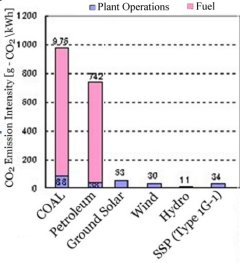
Fig. 2 CO2 Emission
by Plant Type - Credit: USEF[5]
A
U.S. Senate climate bill from 2010 assumed a price
of $15 a ton of carbon dioxide equivalent. Utilities
with large CO2-emitting
generation
fleets
would
be
vulnerable
to
large
costs
associated
with
purchasing
emission allowances, according to a study by Point
Carbon.[6] SSP could be a vital tool in
conjoining
common political desires to address global climate
change without
economically-punitive
energy legislation.
IV. SSP
effectively
uses no land (Fig. 3), they could have
green farms underneath. That
is because
an SSP rectenna would have 95% light penetration, like
chicken wire.

Fig. 3
Ground Solar and Space Solar farms.
Credit: MAFIC Studios
V. Coal,
gas,
oil
or
nuclear
plants
use
huge
quantities
of
water
in their steam cycle.
Uses no water in operation, so does not
compete for
increasingly scarce
fresh water. A typical thermal coal plant withdraws
25,000 gallons of
river
water to provide per average household.[7]
(How
much water does your house use a month?) Output water
temperatures into
rivers are
a related environmental concern that can and have
adversely impact
summer power
plant operations in drought or heat waves. Many other
commodities,
besides
water would benefit, since SSP would use, for example
only 1/100 as
much photovoltaic
(PV) material as traditional ground PV, since SSP
would use thin-film
PV, and
ground solar is usually crystalline silicon PV. SSP
would have a much
higher EROEI
(Energy Return On Energy Invested) than any other
energy source –
eventually
100 to 1.
VI. Use
no
fuel,
and
operational
personnel
would
be
on
Earth,
not
space,
so marginal
operating
costs are expected to be very low. Financially they
are similar to
construction
of big hydroelectric plants, like Hoover dam; high up
front costs, very
low
operating costs.
VII. A PV panel at
GSO
will collect about 9.6 times as much
power per square meter per year as an average location
in the
continental US
and require less maintenance.[8]
If
you consider that ground PV would have to be stored
using CAES, for
example,
with concomitant loss of efficiency to convert it to
baseload, grid
type power,
SSP power provides about 142 times more useable energy
per square meter
per
year.
VIII.Some legislative clean-energy
initiatives
imply serious
adverse economic impact. SSP would take advantage of
our historic
investment in
aerospace and many other technical areas to increase
high quality STEM
jobs,
taking advantage of a multitude of
space-development-related
technologies
- space transportation; telerobotics;
space
communications;
wireless
power
transfer;
photovoltaics;
many
new
materials,
including
high
temperature
superconductors; environmental science;
avionics/control systems; space
environmental
weather; etc.,
IX. In the
conversion
we face to move our transportation
systems to over electric power or alternate liquid
fuels, it should be
pointed
that liquid fuels can be made from SSP power, such as
anhydrous
ammonia, which
can be moved through the same pipelines as gasoline.
It is 111 octane.
We have
been making liquid ammonia for 50 years for farming.[9]
Ammonia is the only fuel other
than hydrogen that produces no
greenhouse gases (GHG) on combustion. Ammonia can be
manufactured from
water,
air and energy. It also
fueled the
X-15 rocket plane!
X. Unlike
bio-ethanol,
bio-diesel, or bio-butanol, SSP
does not compete for increasingly valuable
natural-gas-derived
fertilizer,
crops or agricultural land. Corn, for example, can
continue to be a
major export
instead of a fuel to burn. Corn is a major constituent
of milk, eggs,
cheese, meat,
and even Jack Daniels.
XI. Unlike
nuclear
power plants, SSP will not produce
hazardous waste, reducing nuclear proliferate. The SSP
segment at GSO
would be
relatively easy to defend, while the earth segment
would be hard to
damage,
making harder targets for terrorists. SSP would
provide energy
independence for
those that develop it, reducing hostile competition
for limited
Earth-based
energy resources and dependence on unstable foreign
oil providers.
XII. Perhaps the most timely reason to build SSP:
As
the
oil
and
gas
industry
struggles to maintain production
levels to keep the economy from crashing into
recession or depression,
the environmental impact is escalating. A
controversial
technique called fracking, short for "hydraulic fracturing"
involves
drilling
into "tight gas or oil"
formations of rock, such as shale, and pumping secret
and toxic
mixtures of fluid and sand under extremely high
pressure. This
shatters the rock and allows the gas or oil to flow
more freely.
Reports
in the New
York
Times, an Oscar nominated film
“Gaslands”, and numerous
press
reports have brought new pressure on Washington
and affected
state
governments to protect our water supply, as
energy needs
increasingly compete for scarce fresh water. The
Environmental
Protection
Agency (EPA)
has
initiated
an
investigation into the effects of fracking. The
NYT reports that
internal EPA documents show
the danger to
drinking water from fracking is even greater than
previously understood
- high levels of radioactivity and waste water
treatment plants
unequipped to handle fracking's new pollutants.The
paper also alleges industry and political pressure on
the EPA to limit
the
scope of its safety inquiry.
Another
critical
issue
with
fracked
fields
is
that
they
appear to have
an accelerated
depletion
rate – their production rate declines faster
than conventionally
drilled
gas and oil fields. This can give the impression that
a fracked field
will yield much more gas than it actually will because
the driller is
comparing it to a conventionally drilled gas field.
Politics
plays
a
big
role,
so it
is extremely important to be careful in studying and
documenting the
issue. Don't expect the EPA's report on fracking
to be released
until after people have voted next year, ~ November,
2012. Politicians
only want to lead when their constituents directly
benefit. SSP
would be a massive and exciting new opportunity, with
millions of new
jobs when the industry is built. While some
folks have a gloomy
perspective of the decades, ahead as global
competition for dwindling
resources increases, SSP offers a far brighter
perspective, if
we can swiftly start building clean baseload SSP. We
could move the
environmentally problematic primary energy production
off the planet
while providing much larger quantities of clean
baseload energy to
people with far less damage to our environment.
Eventually SSP parts
may be cost-effectively manufacturing off the Earth,
but Sunsat Corp
should not directly fund any of that work - such as
lunar development.
4. How much
more energy would
SBSP give
rather than the solar panels on Earth now?
Answer 4. A PV panel at GSO will
collect about 9.6
times as much power per square
meter per year as an average location in the
continental US and require
less
maintenance.[10]
If you
consider that ground PV power would have to be stored
to provide grid
available
power. Using CAES, for example, with concomitant loss
of efficiency to
convert
it to baseload, grid type power, SSP power provides
about 43 times more
energy
per square meter per year.
5.
Once the solar panels were in space, how would the
energy be
transferred back
to Earth?
Answer 5. Wireless Power Transfer (WPT)
for long range
today comes in two competing technologies. Microwave
Power Transfer
(MPT) is
the WPT technology currently nearest term available,
but Laser WPT
could also
become competitive IF laser efficiency can be much
improved. It is not
currently an available WPT technology, the best
available is around the
1
micron range, which is fully absorbed by the
atmosphere, so it wouldn’t
reach
the ground. Today LPT suffers from low efficiency, and
therefore too
much
“waste heat”. We will therefore assume MPT unless
otherwise noted.
6. Which of these
ways would be more
effective?
(microwaves or lasers?)
Answer 6. See answer 5.
7.
How much energy would be lost in the transfer from
space back to Earth?
Answer 5. Overall, MPT efficiency from
PV output at GSO
to grid input on Earth is estimated today to be 42%
(Fig.5)[11]
for 5.8 Ghz. We believe
that can be
improved closer to 50% as the DC-to-RF process
matures.

Fig. 5
Microwave
Transfer
Efficiency. - Credit: NRL
To achieve the high beam
efficiency desired the equations governing
microwave WPT mandate very large aperture, or
diameter, transmitters
and
rectennas. The greater those apertures, the higher the
resulting
efficiency. To
reach the high efficiency necessary for economic
operation these must
be
kilometers in size. These dictate that SSP using
microwave WPT is large
–
utility-scale. The original reference study suggested
a 5 Gigawatt
downlink
rectenna broken up into one Gigawatt “chunks” by the
utility
contracting to
distribute it.
Much work
remains to
design and test
arrays as large as these microwave power beaming
designs mandate: ~ 1 km
in space, ~ 5-10 km on the ground,
depending on frequency choice.
8. How much
energy is lost in the
solar
panels currently used on Earth?
Answer 8. Solar panels on Earth range
in efficiency
from about 8% up to about 40% efficient, so their
losses range from 92%
to 60%. Note that
photosynthesis is about
1%
efficient in storing chemical energy.
9. Once the
energy was back on
Earth, how
would they convert it into usable electricity?
Answer 9. The
MPT receiving
antenna is
known as a “rectenna”, or rectifying antenna, which
outputs DC power. This energy would then be
inverted to be fed into the power grid, which is AC
power.
10. How many
watts would it take
to power a
city? Country? The entire Earth?
Answer 10. A US
city of a
million people
would use about 1 Gigawatt for houses and about an
equal amount for
commercial
and industrial uses. The usage goes down at night when
people are
asleep and up
when all the air conditioners are running. You can multiply those
numbers by 300 for
the US
as a whole country, since our population is about 300
million.
Different
countries use very different amounts of energy, some
more efficiently
than
others. Check the World Factbook[12]
or the IEA’s Key
World Energy
Statistics[13]
11. How much energy
would be received in
SSP?
Answer 11. The
GSO orbit is so
huge (164,620
miles) that we could eventually gather many hundreds
of Terawatts there
–
hundreds of times what we use today. The physics of
MPT (see Answer 7)
makes
SSP cost effective only if large quantities of power
are transmitted. 5
Gigawatts per link was what the first major
Reference study (1980) recommended. The physics has not changed,
so MPT
construction
links will likely be handled only by large, utility
scale companies.
Utilities
themselves are forbidden from building power systems
that are not
“off-the-shelf”, as PG&E made clear that they had
accepted zero
risk in
signing their SSP contract with Solaren.
12. What effect
would SSP have on the
environment?
Answer 12. The
environmental
impact of a
MPT “rectenna”, has been exhaustively studied and
found to be generally
safe. Microwaves
are not a new
environmental issue; from your cell phone to TV and
satellite
communications.
Power levels are the real issue, since microwaves are
not mutagenic –
they
don’t break DNA, as ultraviolet and X-ray radiation
does. The radio
frequency
radiation in the beam has less effect than an ordinary
cell phone.
The
power beam would only be
directed at the receiving stations. People would not
be exposed to the
path of
the beam, as it would be almost entirely collected by
the receiving
station
antenna, which would be elevated about 25 feet above
the ground. Birds,
bees
and airplanes are able to safely cross the path of the
beam without any
problem
because the beam bounces off of the aluminum of the
plane and birds are
only
briefly warmed while they might be flying across the
beam.
Today,
thousands of
communication satellites, GPS and DirectTV transmit
energy from space.
Sunsats
would utilize similiar technology. Since it is
important to keep the
downlink
beam locked on to the rectenna to prevent violation of
power density
regulations (and keep power delivery flowing!) there
will be an encoded
phase-locked loop to continuously guide and guarantee
that only when
the beam
is tightly centered on the rectenna will power flow –
otherwise the
beam would
be turned off automatically. SSP will obey all
existing local, national
and
international laws and regulations regarding the safe
propagation of
microwaves.
If
Laser WPT becomes a
viable downlink alternative, other questions arise
because the power
density of
laser would be much higher than Microwave. Since 1
micron laser is the
expected
wavelength to be used, it would be fully absorbed by
the atmosphere.
Therefore,
it has been suggested that such Laser WPT be delivered
to a tethered
stratolite, or blimp, stationed at about 70,000 feet,
well above
virtually all
the atmosphere, including birds.
13. What are the
benefits of SSP?
Answer 13. See
the answer to
question 3.
14. What are the
disadvantages of SSP?
Answer 14. SSP
presents some
unique
challenges. Whether these
are
disadvantages
depends on what power characteristics you prefer:
I. SSP
via
MPT
is
constrained
to
very
large
power
links,
~5
Gigawatts, which makes the cost of the first one very
high and
rather risky to correctly engineer all the numerous
design,
construction and
operational details. Lower power
levels
are not cost effective because the system efficiency
equations dictate
that the
antenna and rectenna apertures, or diameters,
determine the efficiency. They
must be very large, about 5 or 6 km
across for the rectenna and 1 km across for the
transmitting antenna in
space. Laser WPT could
efficiently
deliver lower power levels, although it is not clear
if the cost would
be
competitive at those low power levels or even why you
would want to
bother
going to GSO to deliver small amounts of power.
II. WPT
technology
still needs significant engineering
work to be ready to design and build such huge phased
arrays in space.
We have
never built such a large structure in space before,
ten times as large
as the
International Space Station. This will not be done
quickly so it is
imperative
that we begin soon if we wish to benefit. Like
building a
transcontinental
railroad or a major new dam – plan ahead, SSP won’t
happen quickly.
III. Achieving and
keeping correct phasing of the millions
of microwave transmitters is one problem. Another
issue is that
designers
working on solid state MPT - an alternative to
magnetrons - cannot
overcome the
cooling problems resulting from low efficiency/waste
heat buildup.
IV. Defending the
SSP
satellite system from incoming
meteors, solar flares, and even terrorist attack will
require a new
level of
operational understanding of the space environment,
although we have
considerable experience based on the thousands of
satellites which have
orbited
in space during recent decades.
V. The geometry
of MPT
to Earth would tend to favor
downlink sites nearer the equator, since the Earth is
round and GSO is
over the
equator. Downlink sites at higher latitudes would have
to have an
elliptical
rectenna to collect as much as a circular link at the
equator.
VI. SSP would
continue
degrading the astronomer’s problem
with night sky “light pollution”.
It
would also better enable the construction of large
observing telescopes
in
space and even on the back side of the Moon – which is
the most
radio-quiet
observing environment in the solar system – a very
desirable location.
VII. The extremely
profitable fossil fuel industries which
dominate our planet’s energy supply often make it
difficult for SSP to
receive
a fair hearing and proper funding for the massive
engineering task of
building
it. They naturally prefer non-threatening energy
alternatives, such as
oilman T. Boone Pickens' $80 million lobbying support
for windmills.
15. How is SSP more
efficient than other
sources of
energy?
Answer 15.
First, what is the
best way for
you, as an energy consumer to measure efficiency? Ideally, energy should be
available anytime
and anywhere you want it without harming the
environment we live in, or
our
grandchildren will live in. For a moving vehicle,
liquid fuels have
been the
choice. In your home or another building, electricity
has been the
choice. What
will be the most efficient way to provide this power
ten years from
now, when
fossil fuels become dirtier to obtain and more
expensive? As Appendix A
explains, SSP will be more efficient in providing that
“anytime and
anywhere”
(baseload) energy, since we don’t know how to store
MASSIVE quantities
of power
from irregular and intermittent sources.
16. What action is
being taken to start
using SSP?
Answer 16. The
world leader in
SSP design and
construction is Japan’s well funded USEF consortium. Very little
funding has been
available in
the US on the scale required. The
Space
Solar
Power
Institute,
a
501(c)3
corporation,
and
its
Ga Tech
Workshop (http://sspi.gatech.edu),
have studied this issue
since 1994
and
determined
that the best and fastest way to get SSP built is for
Congress to
charter a
Sunsat Corporation. Congress
chartered
Comsat Corp in 1962 (and also Intelsat) and thereby
created today’s
robust
commercial communications satellite industry. The key legislation to do
this for SSP is
entitled the Sunsat Act. The Sunsat Act would create a
commercial power
satellite industry. Just as cell telephone companies
are not power
companies,
they have very different goals. Communication
satellites (comsats) now
in use
and the power satellites (sunsats) we need, differ in
that sunsats
would
optimize for efficient power transfer, while comsats
have optimized
their
signal to noise ratio.
The
Space Solar Power Institute
has written draft Sunsat legislation and actively
encourages Congress
to charter
a Sunsat Corporation, within the limits of the
educational
activities
501(c)3 organizations can fund.
There
are several poorly
funded small US companies, notably Solaren, that claim
to be building
SSP. Major US aerospace
companies, e.g.
Lockheed-Martin, Boeing, Raytheon, and Northrop Grumman have
been
exploring
the
SSP
opportunity, as well as various
university and government labs partnering with them.
This is an
unfocussed
effort. Astrium, Europe’s largest aerospace company
has been looking
for
support to work with their partner, the University of
Surrey, on laser
power
beaming for SSP. Space Energy is a trans-Atlantic
company with SSP
plans. China,
India, and other nations have been studying how they
could build
Sunsats. Japan’s
18 company USEF consortium is the clear SSP leader
today. While
there
are a dozen SSP efforts now in existence, led by
the
Japanese consortium, they need approximately $30
Billion dollars and
ten to
twenty years to
transition
to an SSP company with positive cash flow. No electric
utility,
aerospace company or other group we can identify in
the US or Europe is
chartered to meet the financial and technical
challenge that building
SSP poses.
17. What countries
or companies are
considering SSP?
Answer 17. See
answer to 16.
18. How would the
solar panels be built?
Answer 18.
Solar panels for
space are a
well understood technology. Several methiods for
deploying them
have been considered from
huge linked inflatables to unrolling large rolls of PV
material like
carpet.
Keeping it in place and thriving in the vacuum of
space through solar
flares
and micrometeorites are key design considerations,
although these are
well
understood for the many smaller satellites that “live”
there now. Space
for
Sunsats along the 164,620 mile arc of the GeoSynchronous Orbit would
have to be
negotiated
when contracts to build are written with receiving
utilities on Earth.
19. How would they
be put into space?
Answer 19.
Since GSO is a high
radiation
environment and very hazardous for long term workers,
virtually all SSP
construction would be done remotely by robots operated
from Earth
(telerobots). There is some discussion about whether
it is preferable
to construct Sunsats in LEO or GSO, but if constructed
in LEO they
would have to slowly
moved to
GSO, where they would operate.
20.
In your opinion, is SSP worth it?
Answer 20.
Unquestionably. It
is the
best economic, environmental, energy and long
term investment in
our future
available today.
It is not cheap, but it is surely worth the trouble
and expense to
provide
clean, unlimited, baseload energy for the foreseeable
future. An SSP industry
would also provide a market
in space for products that might be mined and
manufactured from
resources “up
there” – on the Moon or from passing “Near Earth
Objects”, thereby
productively
expanding our civilization into space. Sunsat
Corporations should not
be
directly financially involved in any business except
providing clean
power to
Earth. They would not for example, build rockets.
Appendix A.
How much more efficient is SSP compared to
ground PV?
PV
panels can be used in space or on the ground. SSP would likely use thin-film PV, since it is much
lighter and therefore less costly to send to orbit. It
is uses 1/100th
as much
material as traditional ground PV. Ground PV is
usually crystalline
silicon,
since the environment on Earth is far harsher –
blowing sand, hail,
bird
droppings and high winds.
We
need to answer this question, “What is the efficiency
of ground PV or
wind
power if converted into baseload (dispatchable) grid
power?” We need to
know
this in order to collect energy from intermittent wind
or ground PV
sources and
using storage convert it to continuous, or
dispatchable, power to the
local
electric grid. ERCOT (they operate the Texas electric
grid) quotes wind
at
7.85% capacity factor because that's how likely wind
is to be blowing
when
ERCOT needs the extra power.
We
are not concerned here with wind or PV energy that is
used locally; not
for grid
usage, such as windmills that for many years have
pumped water from the
ground
to feed livestock on the open range. According to
EPRI, and others,
Compressed
Air Energy Storage (CAES) plants are the cheapest long
term large scale
energy
storage:
There
are two operating CAES plants in the world. The
more
efficient
of
the
two
storage
plants, Macintosh
in
Alabama, is effectively a 27% efficient natural
gas turbine. It
takes
advantage of the unique salt dome geology along the
Gulf coast to store
pressurized air which later will turn the gas
turbine-generator. A
typical
natural gas plant is 34% efficient, but because of the
economics of
being able
to save cheap power from Saturday and using it on a
peak day such as a
hot Alabama
Tuesday, you can provide expensive peak power at low
cost.
Some
proposals envision using other geologic structures,
such as old natural
gas
fields. This has not been done yet but theoretically
could work, at an
undetermined cost. Wind could provide that initial
CAES charging, as
the Iowa
Stored
Energy
Project(ISEP), is now planning to do.
So,
to store the sun or wind with CAES, when it is
blowing, how long do we
need to charge
and store it? Depends on the weather - season and
location have a lot
to do
with that, and even Arizona has a monsoon season. In
many places, weeks
of
negligible sun or wind are possible.
To
provide
power for just one full day, however,
suppose we have a
1 MW sun
or wind power unit that over some length of time (far
more than 24
hours)
stores 24 MWH into our CAES. We can get about 6.48 MWH
generated by our
CAES
whenever we want it. Suppose it takes 4 days of sun to
fully charge the
CAES to
24 MWH. That means we need 14.8 of these average sunny
days to store
our 24 MWh
to cover one sunless 24 hour day for dispatch on the
grid.
Considering
that
we get 9.6 times as much sun per day in space from SSP[14],
it
is
easy
to
see
that
we
get
about
142
times (= 14.8 x 9.6)
as
much dispatchable energy from space,
compared to
terrestrial wind
power or terrestrial sun when we make them "CAES
dispatchable". The
real world is much tougher than our simple example
shows however.
We
have looked at providing for just one sunless or
windless day, but we
do not
really know how much such storage we will need next
month or next year,
which
means our customers are likely to be inconvenienced
when we don’t have
enough
stored. And they will not want to pay for infinite
storage. No one will
agree
to build the massive CAES needed for such storage -
not cost effective.
This
logic model should make clear that being able to get
our power on
demand is
the
most satisfactory way utilities can keep their
customers happy and the
ice cream cold.
|